Disclaimer: the information in this post is mainly sourced from a purely observational perspective; and from subsequent internet research; from watching how people behave and interact, and from talking to members of certain communities, towns and demographics, and in no way claim to be the absolute truth; merely an opinion based upon observational findings. I have tried to include factual references for you to use in order to carry out your own research and also links to official websites.

I don’t claim to know anything about the indigenous people of Australia (for this purpose, indigenous refers to Aboriginal peoples and not Torres Strait Islanders); I’m not overly familiar with their culture, lifestyles or much of their history.
I don’t want to offend anyone with my musings and my myriad of assumptions and if I speak wrongly and have failed to grasp the situation then feel free to offer constructive criticism (I’m still learning about this subject), but I feel it’s only right to try and explain their story in my own words and to make others aware of what I became aware of in the ten months I was in Australia.
Australia claims to be a progressive country (http://australianprogress.org.au/about-us/). Over the last few decades the government has been aiming to give back rights and land to many Aboriginals (what was ironically originally theirs in the first place). And they are also in the midst of a mass ‘reconciliation’ campaign which is an attempt to apologise for past atrocities and is aiming to reconcile differences and historical wrong-doings, including the controversy over the ‘Stolen Generations’ (removal of children from aboriginal families by federal government and church missions between 1871 and 1969, but it is believed children were still being taken in the 1970s. (https://en.wikipedia.org/wiki/Indigenous_Australians).
However, there is still a lot of prejudice towards much of the Aboriginal community, not just from one State in Australia, or one particular city or town, or from one demographic, but from people all around the country.
The reason for this? A saturation of negative opinions; government overturning and back-peddling on legislation; blatant racism; the limited and isolated behaviour and actions of some Aboriginal people that other citizens are subjected to; information (sometimes false) fed to youngsters and teenagers from their peers; and poor education on the subject as a whole.
A lot of this prejudice comes from judging members of the Aboriginal community and observing them as what some people like to call “Dole Bludgers”, or even vagrants, and ultimately, drunks. There are, unfortunately, a lot of aboriginals who litter the streets (and I only use the term ‘littering’, not in a derogatory way but in a way so as to best describe the logistical placement of certain such people and how they have been described to me); disturbing the peace, begging and showing behaviour conducive to anti-social.
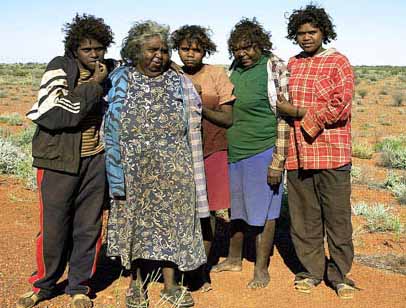
The reason for their ‘miscreant’ behaviour I have noted from speaking to several Australians and shall attempt to explain here in brief and in my own words – in some Aboriginal areas alcohol is not prohibited and therefore the only way for them to celebrate an occasion or otherwise, is to venture into the towns and cities to get hold of liquor and subsequently their only choice is to then stay on the streets/park benches/beaches in order to enjoy a weekend of intoxication. This is not the sole reason but may be one of many reasons a lot of Aboriginals ‘litter the streets’. I was subsequently informed that although this could be a valid reason for alcohol abuse, many Aboriginal people drink in certain towns and cities because they see these areas as part of their tribal land. Lands that were originally theirs before Western settlement and brutality forced them out.
Therefore, in turn, this minority of Aboriginal people who only want to enjoy the land that is rightfully theirs in a way they would have done years ago give the remainder of the Aboriginal people a bad name and reputation, tainting the already superficial view of the indigenous people for the rest of the country, and in some respects, the world (think how some right-winged, fascist British/American people view Islam and Muslims – all of them must be terrorists, right?).
Of course, the prejudice I’m speaking about comes from a small minority of Australians and I don’t want this to sound as if I’m speaking for the majority of the 23 million-strong population. This pertaining discrimination is however, a real problem. A problem that is being reduced but still needs time, understanding and a lot of work to reconcile.
I have witnessed drunk, (allegedly) homeless, aggressive, intimidating and unruly Aboriginals; in Darwin, in Fremantle, in Orange, in areas of Queensland…almost every city I have visited in Australia. I have also had the pleasure of mixing and socialising with a very small minority of educated, kind, friendly and amazingly wonderful Aboriginal people. Unfortunately I haven’t and probably won’t have the opportunity to mix with the REAL Aboriginals. The real tribes. The real communities. And this is something many Australians have not done either (although Aboriginal tourism is on the rise: http://www.aboriginalaustralia.com.au/ and http://www.tourism.australia.com/aboriginal.aspx).
According to history and educational texts, the aboriginals are an incredible set of people. They have inhabited this wonderful ‘island’ in the middle of the South Pacific for over thousands of years, only to be brutally pushed out of their homelands when the British invaded Australia and claimed the land as their own in the late 1700s/early 1800s.
Resistance to ‘invasion’ was often violent and the Aboriginal people did try to defend their land with force, often resulting in the killing of many white settlers. However, this did not come without a counter-attack and the British/Europeans were responsible for some of the most famous massacres in Australian history – the Pinjarra massacre and the Myall Creek massacre.
Aboriginal traditions are something very unfamiliar to those of the Western and modern world, and are so deep and complex that they may never be fully appreciated or understood by the likes of you and me. Stories and legends have been passed down through the generations and have often fallen prey to the age old adage of Chinese Whispers, mainly because of the lack of historical documentation and factual misrepresentation. Therefore we will never fully know the true extent of the early Aboriginal way of life.
We do know though that the Aboriginal people were highly nomadic and often moved around in their clans to benefit from and reap the land. Their rituals, their community spirit, their artwork, their language, their family units; the way they raise their children; it is all alien to the’ West’ but it is their way of living and it is fascinating. And it is this way of living that the settlers tried to change and continue to change to this day. Although their culture should be and is respected (in most circles), it should also be tolerated by Australian people, the Australians who forced them out of their homes and forced them to conform to western standards of ‘civilised’ living all those years ago.

Even though the Western culture now dominates a lot of the Aboriginal population, and some elders still find it alien, it has generally been accepted by a lot of the indigenous communities and has given them a better chance in life with more opportunity and a higher standard of living in a country that continues to grow and develop and change year after year.
And since the early 1900s things have gradually changed and progressed in terms of fairness and equality for Aboriginal people and the relationship between them and Australian people. Many Aboriginal people fought for Australia in the World Wars and despite the colourful and violent history between the two races, they continue to want to integrate into modern society and many Australians, including past and present governments have tried to atone for their atrocities.
In the 1960s Aboriginals were given the right to vote in the Commonwealth elections and in 1965 a Freedom Ride organised by students from the University of Sydney encouraged Aboriginals to resist discrimination. The 1970s saw some controversial U-turns but in 1999, John Howard’s government passed a Motion of Reconciliation which named the mistreating of Aboriginal people the most ‘blemished chapter in Australian history’.
However, in 2007, things took another turn and what was seen as a racially discriminatory Emergency Response to alleged child abuse among Aboriginal communities was introduced which resulted in the banning of alcohol in some areas and a quarantine of a percentage of welfare payments (https://en.wikipedia.org/wiki/Indigenous_Australians).
In 2008 though, a public apology for members of the Stolen Generations was issued by Prime Minister Kevin Rudd and actions of many other politicians from both Liberal and Labour camps continue to make peace to this day.
I am led to believe however, that the last Labour Government criticised Rudd’s apology and refused to officially say ‘sorry’ to the Aboriginal people because it would be seen as an admittance of wrong doing and an apology for something that previous governments before them approved, i.e. they didn’t sanction the barbarity so why should they apologise?
The current Tony Abbott government has attempted to become the government for Aboriginal affairs but the PM is often met with criticism as his opinions, understandings and views have been noted to be hypocritical, naïve and ignorant; and the party has often fallen short on promises to ‘close the gap’ between indigenous and non-indigenous people.
While the struggle for Aboriginal acceptance and equality continues, I can’t help but think there are certain parts of Australian society unwilling to progress, compromise and work with the indigenous people in order to create a harmonious place to live.
What I feel most upset about is the ignorance some people still possess today. The racism, prejudice and unforgiving natures of some ‘civilised’ Australians is beyond my comprehension. It’s the same the world over though (South Africa, The USA, Britain, Israel, the Ukraine…).
Yes, I can understand the reasons a lot of Australians have for despising some parts of the Aboriginal community. In certain towns there are a lot of problems – crime perpetuated by a minority of the Aboriginal peoples, poor housing, lack of social interaction and very low school attendance and participation (much of which can’t be attributed to the communities themselves but to government failings). But this is in no way a sole reason to tar the whole indigenous population with the same brush. It’s just ignorance.
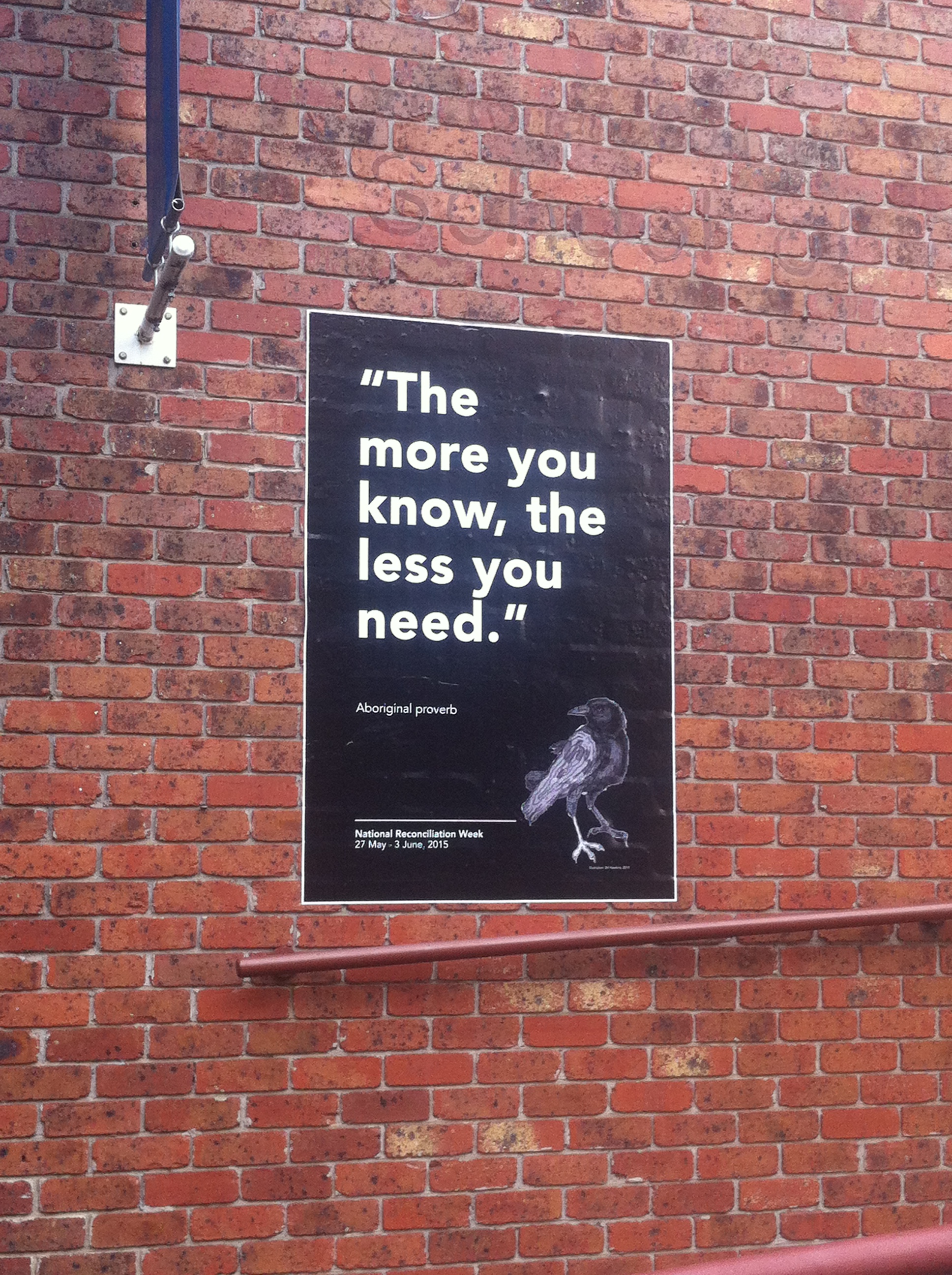
While I was in Australia, visiting different towns and cities I was alerted to some of the campaign and promotion of Reconciliation Week, 2015 (http://www.reconciliation.org.au/nrw/what-is-nrw/). I saw posters placed around Aboriginal arts and cultural centres and various universities, highlighting the fact that ‘knowledge is power’ in as far as educating people about the history and culture of these people goes. ‘The more you know, the less you need’, a famous Aboriginal saying, was a prominent slogan I saw plastered on walls in certain areas in and around Melbourne. It was this encouraging support that made me ever more interested in Aboriginal history and led to me collating all I’d learned and seen in order to produce this piece of writing.
The history and plight of these people is fascinating and it would be a great shame if future generations of Australians, and migrants to the country, did not learn to appreciate and consider the facts surrounding why and how the Aboriginal people got to where they are in present day Australia. Past generations may have their own opinions and judgements, and the governments may try, fail, contradict one another or succeed in their reforms, and I may be naïve in thinking differences can be resolved and prejudice eradicated; but it’s only through education, integration and opportunity that the Australian government, communities and its citizens can all work together to achieve a peaceful co-existence.
 Chasing Amy-Lou