“Maybe that’s what hell is, the entire rest of eternity spent in fucking Bruges”
In Bruges, 2008
Colin Farrell’s character, Ray, in the film In Bruges, may have disliked Bruges somewhat, he may have found it hellish and boring and full of midgets but for me, Bruges was delightful, a tiny corner of the world that felt dream-like and idyllic; the highlight of my time in Belgium.

Often referred to as the Venice of the North, I felt this description particularly misleading, as Bruges is no imitation of another place, it stands on its own, unique in its sheer beauty. The geography of Bruges is compact, making it wonderfully easy for visitors to explore the city on foot, by bike and of course, on water. The numerous canals in the city link Bruges to the coast and viewing the city on water is perhaps one of the best ways to take in this picturesque idyll.
As with the other cities I’d visited in Belgium, Bruges did not disappoint when it came to providing an array of churches and its clear to see why, as the majority of its 120,000 population are Roman Catholic. Perhaps the most impressive of all the churches in Bruges is the Basilica of The Holy Blood, situated near the City Hall which itself is a thing of beauty – Gothic in style and is one of the oldest town halls in Belgium.
Bruges is also famed for its museums, as with many other cities in Belgium, as the Dutch have a passion for collecting and recording. The Groeninge Museum, situated south of the Markt (the main square in Bruges) is open Tuesday to Sunday and has a small entrance charge; here you can see some of the best Flemish Primitives from early Flemish artists. There’s also The Arentshuis (same opening times as the Groeninge) which contains an extensive art collection of Sir Frank Brangwyn, a Welsh artist born in Bruges in 1867. The Gruuthuse Museum, also located south of the Markt, in the same geographical space as the aforementioned museums, houses lacework and tapestries as well as musical instruments. If your cultural tendencies stretch further than art museums then maybe a trip to the Brouwerij De Halve Maan (Brewery of The Half Moon) is more up your street. As I’ve mentioned before, Belgium is renowned for its beers and according to the Berlitz pocket guide to Bruges and Ghent, Bruges beers are exceptionally good. The Half Moon has been brewing in the city since 1564 and produces a local beer called Strong Henry. A tour can be taken around the museum which lasts 45 minutes. There is a charge for entrance and the site is open at varying times throughout the year.

When I visited Bruges, it was Christmas time, so as with Ghent and Brussels, the main square (Markt) was packed with tourists, Christmas markets and an ice skating rink. The city was bustling with activity and even though the festive period may have attracted more tourists to the area, I couldn’t help but think that Bruges was one of those places that was always busy, regardless of the time of year, and a lot more so since the 2008 film of the same name.
Its popularity, for me, was nested in two or three major attractions – chocolate, food and the Belfry. Yes, I had heard of Belgian chocolate before, and my friend Pieter informed me that the best chocolate shop in Belgium was in fact in Bruges. Yes, I had sampled the food, including the famous Belgian dish of frites with mayonnaise but what I had really come to Bruges for was to climb the Belfry. Shamefully, this had only become a desire of mine since I watched those fat Americans get stuck on the stairs when watching In Bruges yet I couldn’t help but feel that the Colin Farrell and Brendan Gleeson film had made the city all the more endearing.

On arrival at Bruges station we walked the short distance down the Zand until we reached the main tourist area. Deciding to meander through the cobbled back streets was possiblly the best idea we had. Now, as an avid traveller and probably a bit of a tourist on occasion, it’s sometimes nice to avoid the crowds and take in the peaceful and more serene areas of a city, far from the rabble, away from the map-toting, bumbag wearing keensters who have no idea where they’re going. Our walk led us round the quieter, residential parts of the city, passed tiny boutique shops and cute little cafes. We took in the churches and marvelled at the steeples and spires we could see over the tops of the minute houses, the Belfry always standing out, invading the skyline.
As we stepped out from our peaceful little haven we were bombarded with a sea of people, lots of people and the majority of them, clearly tourists. We had arrived at the Markt. The main hub of activity for the city of Bruges, a huge square, surrounded by shops and cafes, hotels and tourist information points, trinket shops and chocolatiers. People lined the streets, seated at tables, sipping coffees and hot chocolates in order to keep warm, or enjoying the beers and wines while tucking into deliciously smelling meals. And there, directly in front of us towered the magnificent Belfry, dark and invading, almost spooky in its medieval stature, a prominent landmark for this picturesque city.
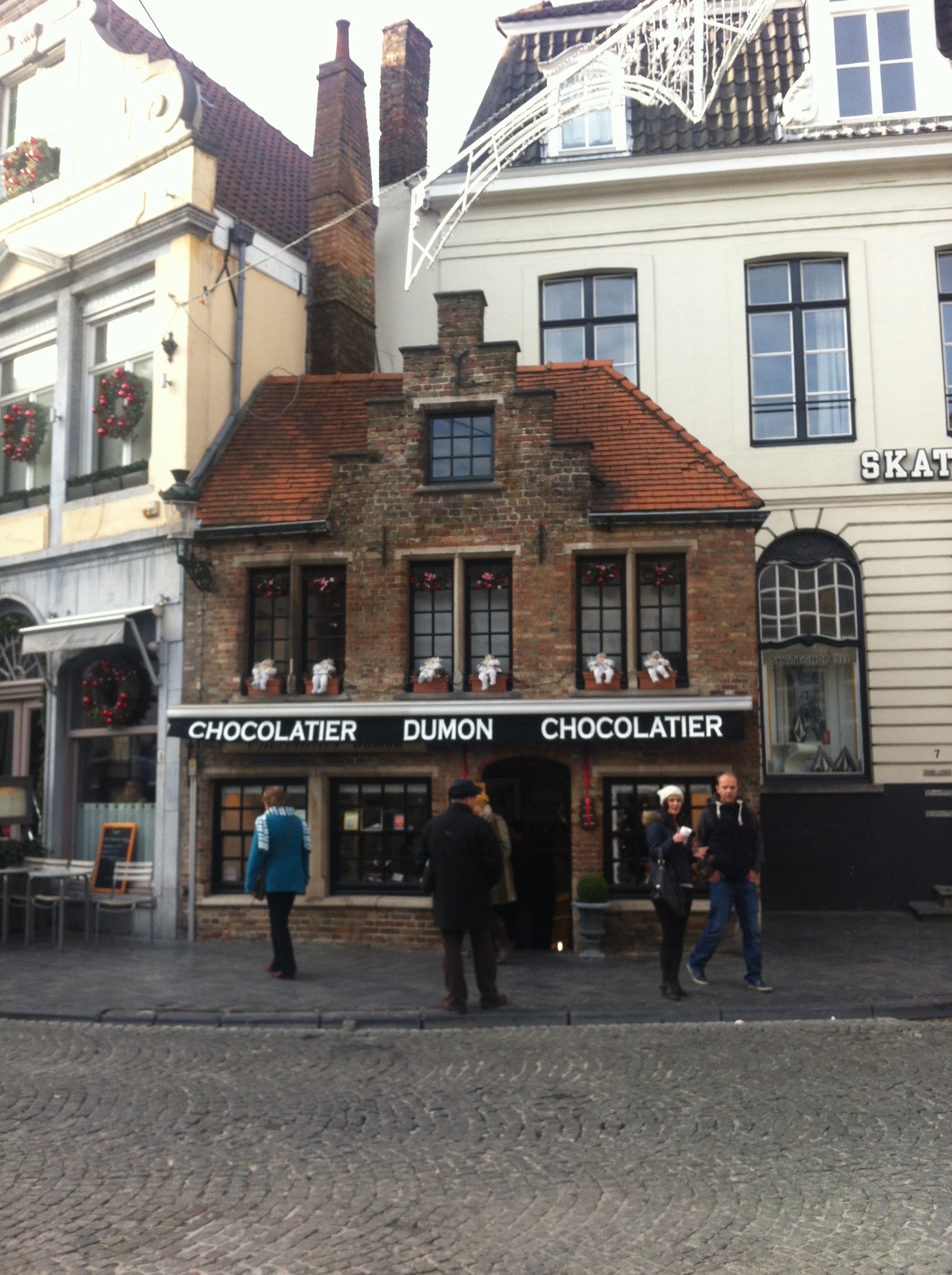
Before making our way to the Belfry, I positively had to sample some of the best chocolate in Belgium, so it was that Pieter directed me to the Dumon Chocolatier, a tiny little chocolate shop set just back from the Markt. Now, I don’t profess to be a chocolate connoisseur, much as I’d like to be, but I do pride myself on being able to sniff and taste out a decent chocolate every now and then. Dumon Chocolatier was up there with the best I’d ever tasted – the chocolate was smooth and velvety, scrumptious and flavoursome and just absolutely devine. My mouth is watering just reminiscing…
Obviously, and in true tourist fashion, I purchased my little box of chocolates and we continued on our tour. Walking toward the Belfry, my heart dropped a little as I saw the size of the queue. I had expected a bit of a wait to enter Bruges’ most famous landmark but not a wait that would put the queue at any English bank during lunchtime to shame. Alas, and with much sighing, we joined the queue and decided to entertain ourselves by making up stories about the people stood around us. Stifled laughs ensued and a few funny looks were directed at us but we were too busy trying to stay warm to even care.
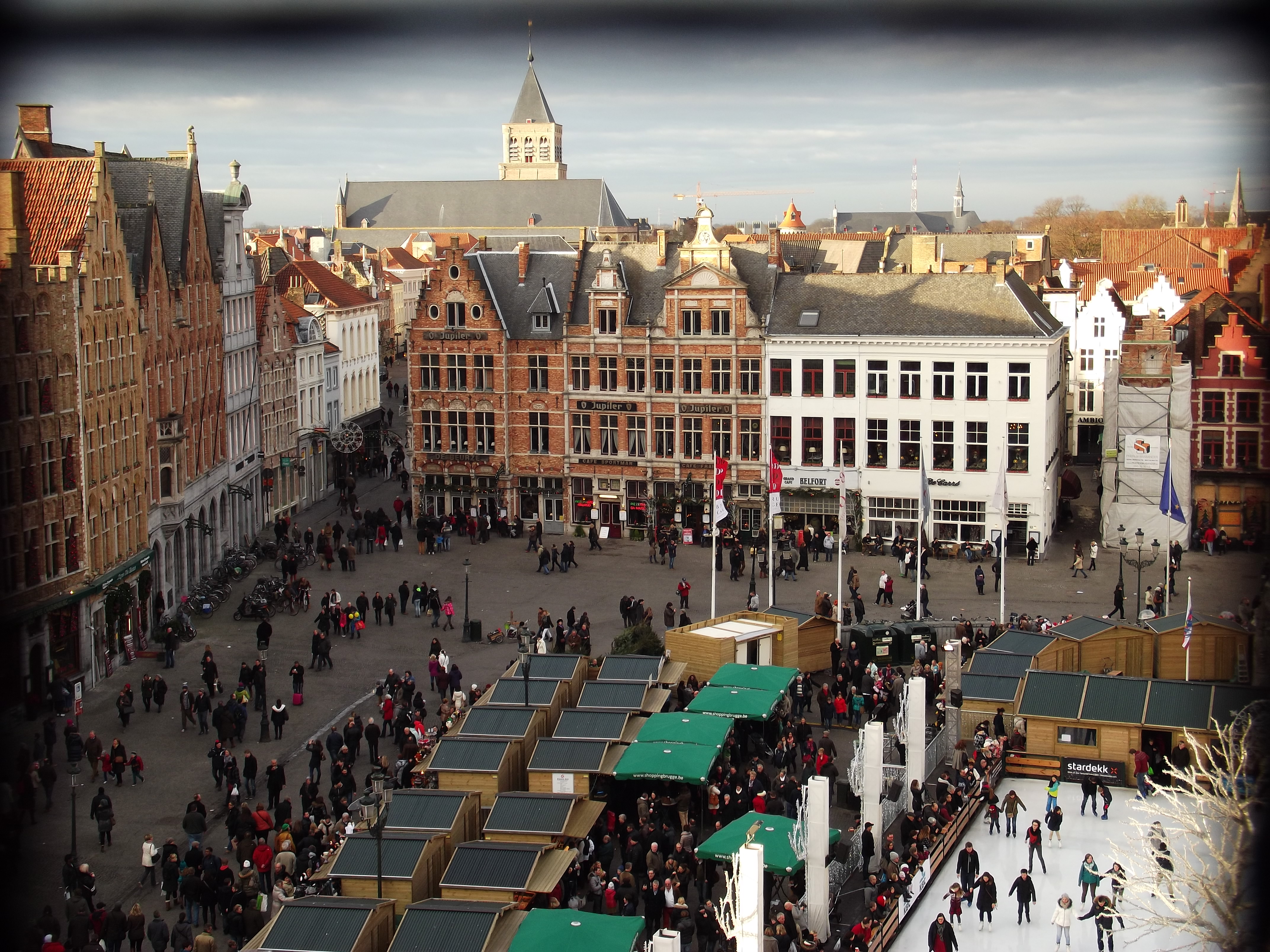
After what seemed an eternity we finally paid the eight euro entrance fee and began our ascent of the 366 steps, taking in the impressive clock mechanism and a carillion with 47 silver-toned bells to reach the top of the 83 metre tall tower. Ray and Ken from In Bruges were not wrong – the staircases were extremely narrow and quite difficult to negotiate at certain points. Now, I ain’t being funny but if you’re on the slightly more obese side of the weight scale then I’d probably avoid trying to climb the steps and just stick to taking pictures from the ground, you’ll definitely thank me for it.
Reaching the top was possibly the Piece de Resistance of the whole of my trip; the spectacular view from the Belfry was just truly incredible. An amazing 360 degree panoramic taking in miles and miles of landscape. I was quite blown away…literally in fact, as the temperature was deceptively cold and the wind was definitely picking up. We took the obligatory snaps and made our way back down…slowly…and carefully.
As the day wore on, Pieter and I decided to fill the remaining time we had in Bruges by walking around the city, taking in the less-touristy areas, cutting through small back streets, discovering small, hidden away restaurants and quaint little shops. We then found ourselves in Koningin Astrid Park, the park where Ray goes to contemplate committing suicide in the film In Bruges. With an inviting veranda and a small children’s play area, the spacious park also contains a small pond with a fountain and I could picture how stunning it would look in the summer.
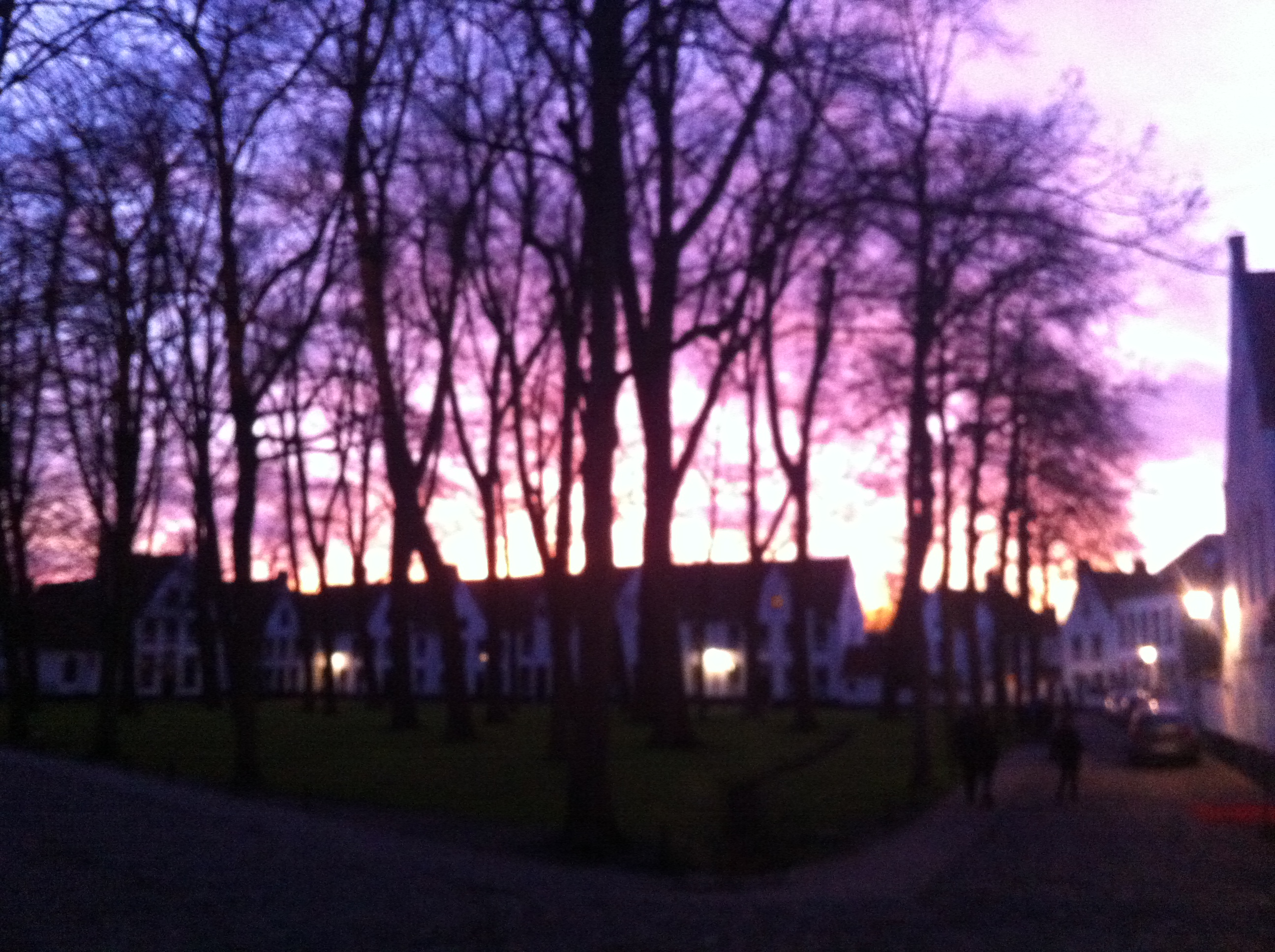
The sky began to darken and the streetlights lit up the canals and buildings. We walked further and crossed the waters, taking in the old hospital, Oud Sint-Jan and the famous Begijnhof monastery which was so peaceful and quiet, a welcoming contrast to the overcrowded centre.
As darkness set in, we made our way to the station to catch the train back to Ghent and I reflected on my time in Belgium. Brussels had been interesting, huge, grey, a hub of economic activity and importance; Ghent had been comfortable, welcoming, warm, and somewhere that could easily feel like home; while Bruges had been everything I had expected and I felt truly blessed to have had the opportunity to visit this enticing city. Now, I’ve not yet been to Venice but from my armchair knowledge I can say that naming Bruges the Venice of the North is far from the truth; even referring to it as Belgium’s Amsterdam is a pretty false proclamation too. Bruges is just that, it’s Bruges; it isn’t Venice, it isn’t Amsterdam and it definitely isn’t anywhere close to hell. Bruges has its own character and its own story, something anyone planning to visit Belgium should go and find for themselves.
 Chasing Amy-Lou
I visited Bruges in summer. It was lovely! Also did some beer tasting. Nice post!